The short answer
Identify the affected pipe segment and obtain a condition-and-access assessment before comparing repair methods. A house’s age or foundation type alone does not define the excavation scope.
In this guide
Locate the actual concern
Ask whether the issue involves an exterior private sewer lateral, under-building drainage or both. Request a marked plan or simple sketch showing the segment assessed. Terms used loosely in a conversation can conceal a substantial difference in access and restoration.
A slab foundation does not tell a homeowner where the failed segment is. Likewise, a statement that a pipe is old does not establish its present condition. Have the professional connect the recommended work to observed evidence rather than starting with the most disruptive imagined scenario.
Obtain a usable inspection record
Request the report, video if obtained, inspection limits and the professional’s explanation. Ask what could not be assessed and whether further investigation is recommended. Keep the original files rather than only a salesperson’s summary.
If you are evaluating a purchase, coordinate access and deadlines through the transaction participants. This article cannot decide whether to waive a contingency or whether a specific defect is acceptable. The useful output is a record that your advisers and contractors can evaluate.
Compare options against the same segment
Different repair approaches may have different suitability requirements. Ask the contractor to explain why each proposed method fits the actual condition and what approval is required. Do not assume a lining suggestion in a Reddit reply is appropriate for an unseen pipe.
Where the property is covered by EBMUD Private Sewer Laterals, make sure the proposed outcome can support the applicable verification process. Elsewhere, identify the responsible sewer and permitting agencies. A repair method that sounds minimally disruptive still needs a complete scope and the required acceptance.
Include access and restoration
Ask which floors, walls, landscape or paved surfaces are affected, who opens them and who restores them. Identify whether matching finish materials are available and which portions are excluded. Separate temporary access from permanent reconstruction.
A hypothetical interior repair might have modest plumbing scope but consequential floor restoration. Another might involve exterior access only. Comparing just the plumbing labor would miss the difference that matters most to the owner.
Make uncertainty visible in the proposal
Request a base scope with the observed evidence, defined limitations and a process for approving changes if investigation reveals a different condition. Ask what records will demonstrate completion and which follow-up tests or inspections are included.
Your checklist is segment location, evidence, inspection limits, method suitability, authority review, access, protection, restoration and closeout. It replaces the false choice between “everything must be demolished” and “a trenchless method will solve anything” with a property-specific decision.
A scope sketch that can prevent a false comparison
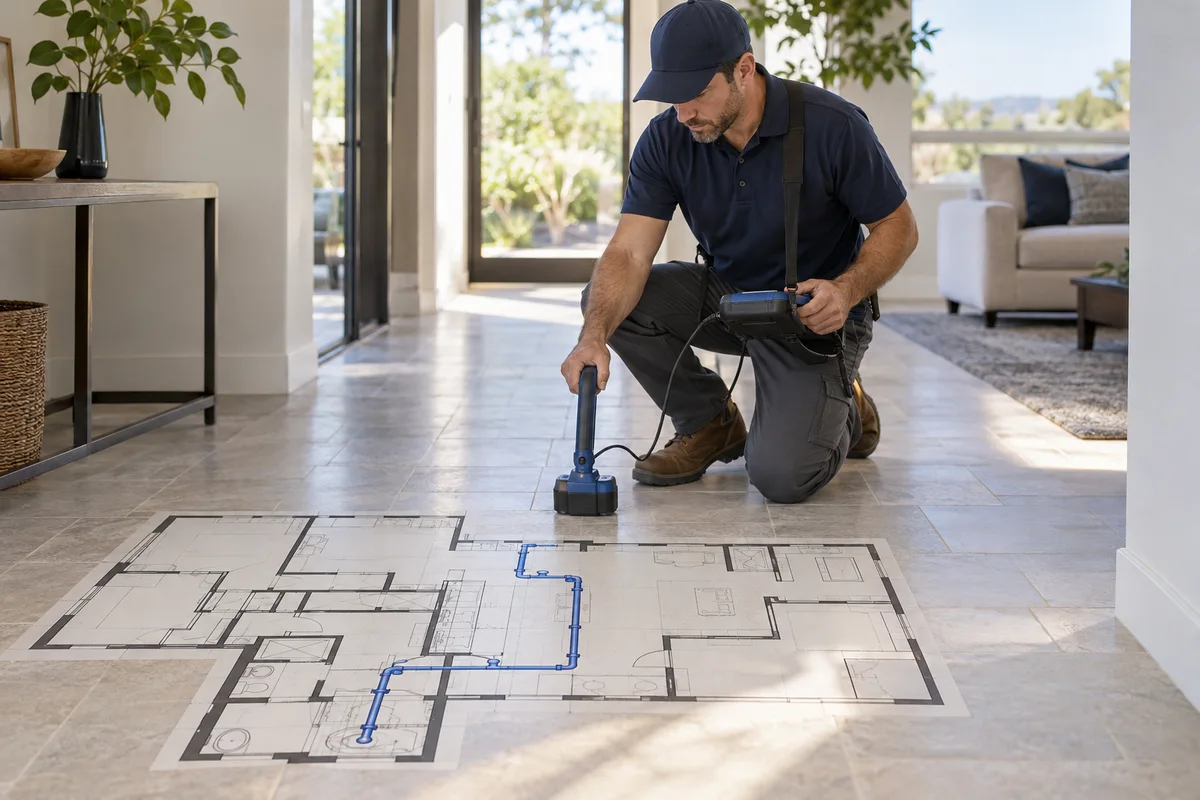
Ask the inspecting professional to mark the observed segment on a simple plan and identify known access points. The sketch need not be a homeowner-produced construction drawing. It should help everyone distinguish the exterior run from any under-building work and show where the assessment stopped.
Give the same record to each bidder and request a method explanation tied to those findings. Ask what additional investigation could change the recommendation. If one proposal assumes a repairable segment and another assumes replacement of a larger route, the totals are not yet comparable.
For a hypothetical slab house, the owner’s most important concern may be restoration of a continuous finished floor. Have the team explain which surfaces are actually expected to be affected and which remain uncertain. Ask who evaluates the availability and appearance of matching finish material. A minimally described plumbing quote can leave that consequential cost entirely outside the comparison.
Do not treat “trenchless” as a complete outcome statement. The contractor should identify suitability, access, limitations, required acceptance and the finished result. Similarly, an excavation proposal should explain why the affected route and extent are needed rather than assuming the homeowner understands the method from a price.
Before signing, write a short owner summary: the identified segment is addressed by this proposed scope; these areas are restored; these uncertainties remain; these approvals and records are included. Ask the contractor to correct it. The exercise exposes misunderstanding before disruption begins and leaves a useful record for a future sale or repair. It also gives you a rational basis for deciding whether more investigation is worth its cost.
Related questions
Does a slab foundation mean all floors must be removed?
No conclusion can be drawn from foundation type alone. The affected segment and viable access must be identified through a property-specific assessment.
Can I choose pipe lining from a quote alone?
Ask for the condition evidence, suitability explanation, required approvals and complete restoration scope. The method should follow the assessment, not replace it.
Official sources
Why readers ask this question
These public discussions informed the topic. Individual experiences are not permit rules, verified prices or professional advice.