The short answer
Agree on the proposed location and responsibilities before work starts. Local approval, utility coordination, electrical installation and building-surface repairs need one coordinated scope.
In this guide
Start with a location review
Ask the electrician to review the proposed location together with the remodel drawings and utility requirements. Do not choose the final location solely because it disappears behind a landscaping feature or frees a kitchen wall. The location must work for the service arrangement and applicable approvals.
PG&E Pre-application Resources helps identify the utility application route. Use it with the project professional, especially if the relocation changes more than the box on the wall. A homeowner should not direct movement of service equipment based on a photograph or a forum comment.
Separate approvals from appointments
A building permit is not a scheduled utility visit. A utility application is not evidence that local work has passed inspection. Put both streams into the project schedule and identify who confirms each milestone.
Ask who requests disconnection and reconnection, who meets the utility if required, and what documents must be available. Record the contingency if work cannot be completed as expected that day. The responsible parties must define any safe temporary arrangement; do not improvise one to preserve a move-in date.
Include the surfaces around the work
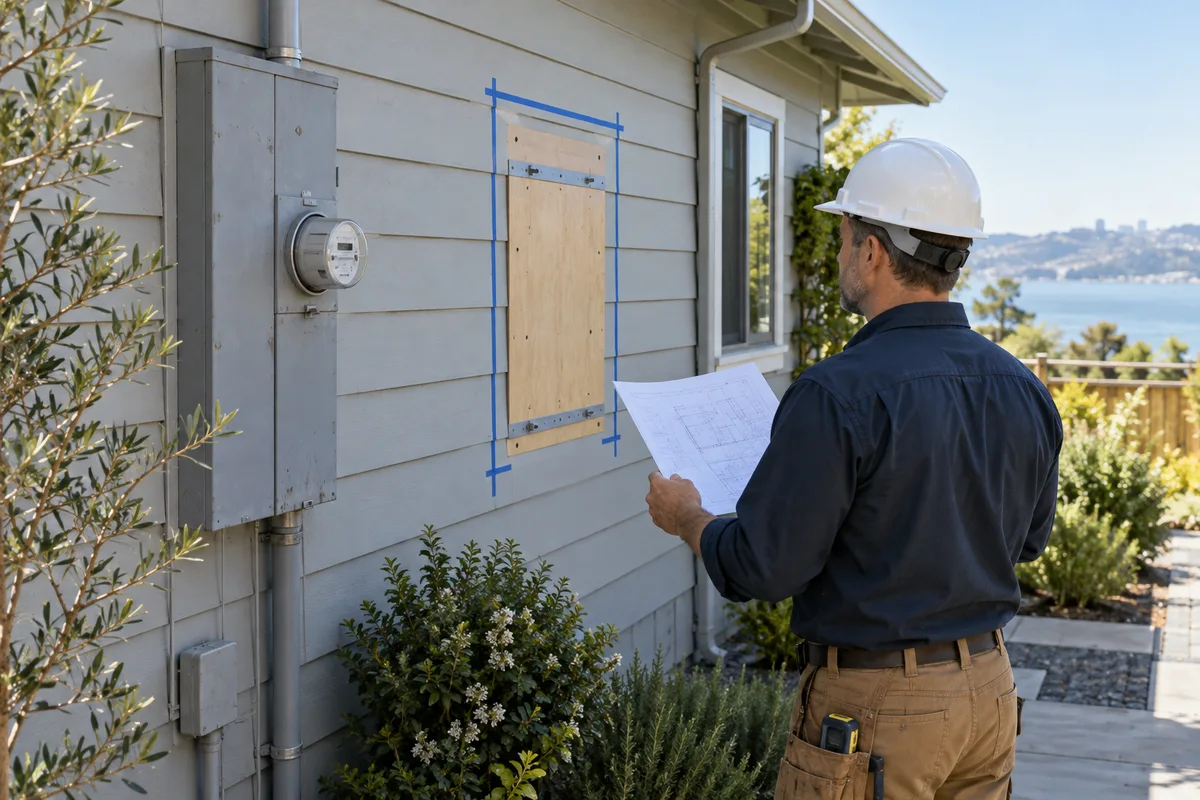
Panel relocation can affect wall finishes, weather protection, landscaping or interior access. Walk through the old and new locations with the contractor and note who patches each affected surface. Ask whether painting, texture matching and final finish are included.
A hypothetical owner may accept a quote for electrical work and later discover that the old opening remains another trade’s responsibility. The remedy is not to assume that “complete” means every finish. Define the finished condition at both locations before comparing totals.
Keep the kitchen or exterior plan synchronized
New cabinets, cladding, windows or utility equipment can compete for the same space. Send the coordinated plan to the relevant trades. If one layout changes, have the professionals decide whether the electrical or utility documents need revision.
The PG&E Residential Project Resources materials are useful for understanding the service-upgrade process, but your approved project information controls the installation. Avoid ordering custom finishes around a proposed equipment layout until the people responsible for that layout have confirmed it.
Prepare for handoff and closeout
Create a contact sheet with the electrician, general contractor, utility project representative and permit number. Before the coordinated work date, confirm the current plan version, site access and outstanding dependencies. “Everyone knows” is not a substitute for naming a person responsible for each step.
Afterward, retain inspection records, final scope, equipment information and the updated directory of circuits. Ask which remaining tasks affect final sign-off. A new panel can be physically present while restoration, documentation or approval remains incomplete.
A handoff checklist for the planned work date
Prepare a one-page handoff with four named roles: the electrical installer, the utility contact, the local inspection coordinator and the finish-repair contractor. The same company may fill more than one role, but none should be left as “someone else.” List the current drawing and the confirmed prerequisites beside each name.
Ask the electrical contractor what owner access is needed and how the household should prepare for the planned interruption. Have the provider address essential household needs through an appropriate project-specific plan. Do not improvise electrical arrangements because a forecast duration seems short or because a neighbor used a temporary setup.
The old location also needs a completion definition. Ask whether abandoned openings, labels, surfaces and surrounding finishes are included in the contracted result. At the new location, ask which final items must remain accessible and how later landscaping or cabinetry should be coordinated with the installer’s guidance.
A hypothetical homeowner might have a painter booked for the day after electrical installation. That booking should depend on the actual readiness of surfaces and required reviews, not simply the electrician’s first mobilization date. A named coordinator can release the painter when the relevant work is ready.
After the appointment, update three separate statuses: physical installation, service connection and local completion. Add finish restoration as a fourth if it is outstanding. This prevents a photograph of the new panel from being treated as proof that every contractual and approval obligation is closed. Store the final statuses and their supporting records with the project, so the next contractor can understand the relocation without reconstructing it from text messages.
Related questions
Can the electrician move the service without PG&E involvement?
The exact scope determines the utility role. Ask the electrician and utility representative to confirm the coordination required; do not assume city approval authorizes utility-side work.
Who fixes the old panel opening?
The contract should name that party. Electrical, weatherproofing, wall repair and paint may be separate scopes, so describe the required finished result explicitly.
Official sources
Why readers ask this question
These public discussions informed the topic. Individual experiences are not permit rules, verified prices or professional advice.