The short answer
Build a chronological file that connects scope, authorization, payments and the problem. A reviewer should be able to follow events without relying on your memory or reading an unorganized message dump.
In this guide
Preserve the original documents
Collect the signed agreement, revisions, approved changes, invoices and payment proof. Save messages in a form that preserves sender and date. Keep photographs with their original files. Make a separate working chronology rather than annotating the only copy of a document. Label missing records as missing instead of reconstructing them as if they existed. See CSLB consumer guidance for the applicable official information.
Write a short factual timeline
Record when the agreement was made, work began, changes were proposed, payments occurred and concerns were reported. Include the contractor’s responses. Separate observations from conclusions. For example, state that a room remained unfinished on a date rather than asserting the contractor never intended to finish. The timeline should let someone identify which documents support each event.
Organize the question to be resolved
Create a list of issues such as incomplete scope, disputed authorization, defective work or accounting discrepancy. Attach the supporting document references and the remedy you are requesting. Do not mix unrelated frustrations into one long accusation. Different issues may need different evidence or professional input.
Prepare a shareable packet
Use an index and sensible filenames. Remove unnecessary private information from copies shared outside the relevant process while preserving originals. Ask the receiving agency, insurer, surety or lawyer what format and documents it needs. A coherent packet helps review; it does not guarantee a particular outcome or replace deadlines.
A dispute packet that stays focused
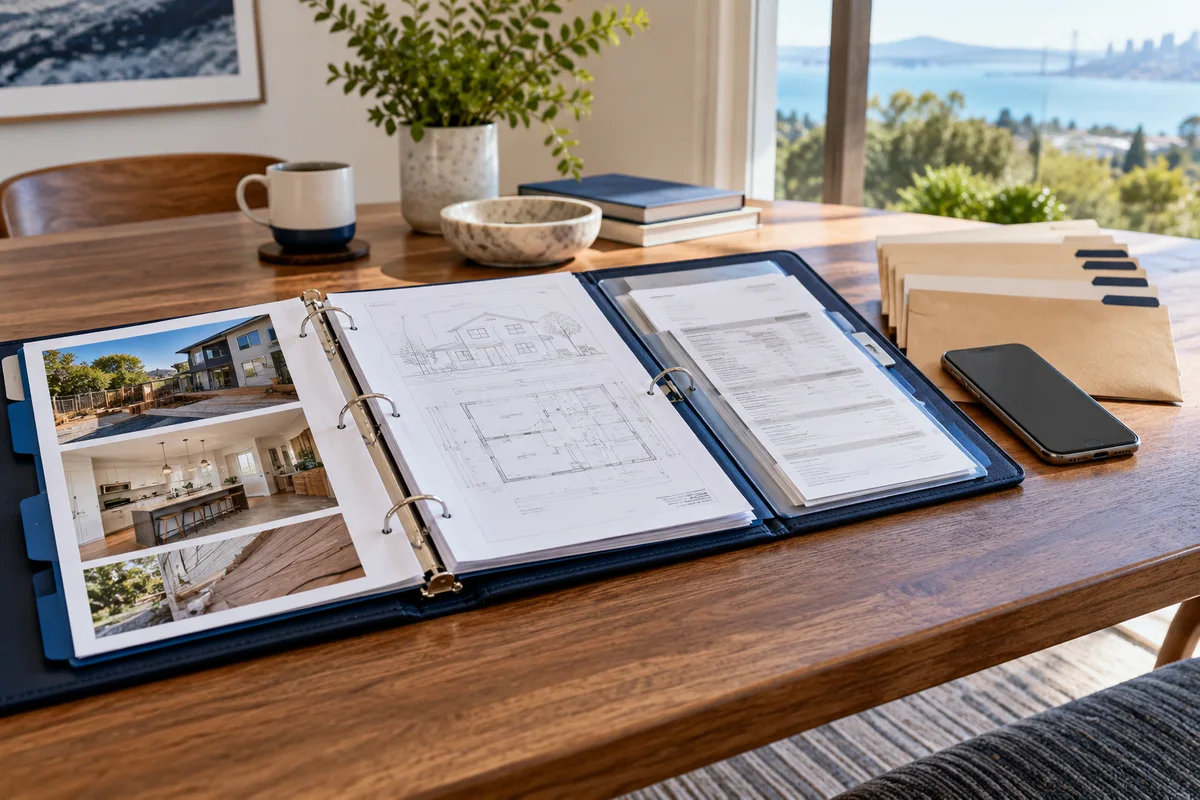
Create an index with four parts: agreement, financial record, work record and communications. Within the agreement section, include the signed contract and relevant attachments in their actual versions. In the financial section, include invoices, payments, credits and your reconciliation. In the work section, include dated observations, inspection records and professional assessments. Keep communications chronological and complete.
Write a one-page overview identifying the parties, project, current status and questions to resolve. Use restrained language and avoid claims about motive you cannot prove. State the requested outcome clearly, whether it is completion, correction, an accounting explanation or another remedy. A long emotional account can make the central issue harder to find.
For each issue, cite the document or photograph supporting it. If you lack evidence, say what is missing and whether you requested it. Do not create a backdated note that appears contemporaneous; label a later recollection as such. Preserve original files and use copies for highlighting.
Track submissions and responses. Record which agency or adviser received the packet, when, and any reference number or requested follow-up. Different recipients may need different forms, so an indexed file does not replace their application process. Confirm deadlines from appropriate sources rather than assuming an active conversation pauses them.
When new information arrives, add it to the chronology and update the overview without erasing prior versions. If the contractor corrects an issue, record that accurately. A credible packet includes improvements and responses as well as problems. Before sharing publicly, consider whether it contains private addresses, account details or unsupported allegations. The intended audience is the relevant review process, not an online crowd. A focused factual record supports better advice and reduces the chance that a solvable accounting issue becomes confused with a technical or legal dispute.
Follow through on the decision
Before submitting the file, ask someone unfamiliar with the project to locate the agreement, the disputed charge and the evidence of the reported condition. If the person cannot find them quickly, improve the index rather than adding more narrative. Check that dates and amounts match the originals. Remove accidental duplicate files from the review copy while retaining your complete archive. Include a list of outstanding information requested from the contractor. This last quality check reduces the chance that a reviewer spends time untangling your filing system instead of assessing the issue. Keep proof of what you submitted and when. If the recipient requests a different format, adapt the copy without altering the underlying evidence or losing the original record.
Decision checklist
- Preserve originals and create a separate working evidence chronology.
- Index contract, financial, work-condition and communication records for easy review.
- State the issues and requested outcome using supported factual language.
- Track submissions, responses and outstanding information without assuming deadlines pause.
From message history to evidence index
Hypothetical example. Suppose a fixture change was discussed across twelve texts. Save the complete exchange, then make a timeline entry pointing to it and noting what was proposed, priced and accepted or disputed. Do not select only one favorable sentence and omit the surrounding context. The index makes the full evidence easier to find without distorting it.
Related questions
Should I include only evidence supporting me?
No. Preserve the complete relevant record, including responses and your own changes.
Does a detailed file guarantee recovery?
No. It improves clarity and review but does not decide the merits or available remedy.
Official sources
Why readers ask this question
These public discussions informed the topic. Individual experiences are not permit rules, verified prices or professional advice.