The short answer
Compare complete scope rather than a price per square foot. Separate design, agency charges, site work, utility coordination, inspections and completion documents, and identify which amounts are quoted, allowances or still unknown.
In this guide
A headline price is a starting point
An ADU offer may describe a building shell, a standard design, a package of finishes or a broader construction service. The number is not meaningful until its boundary is clear. Ask the provider to identify the exact drawings, site assumptions and included services behind it. Compare that boundary with your property and intended use.
Use three labels in your budget: firm quoted scope, provisional allowance and unresolved item. Do not place an unknown cost in a zero-dollar cell. A blank line labeled utility connection unresolved tells you more than a total that silently assumes the connection is included.
Separate design and permitting deliverables
Ask whether the design price includes site-specific adaptation, engineering identified for the project, application preparation and responses to review comments. A preapproved standard design still has site-specific responsibilities described in San José: Preapproved ADU and Site-Specific Application. Confirm who performs those services and whether the same assumptions appear in the construction proposal.
For agency charges, locate the applicable schedule through San José: Building Permit Fees and Estimator and request a project-specific estimate when appropriate. A contractor's permit-services line may also contain labor and coordination. Keep those services separate from amounts paid to the agency so later changes can be understood rather than argued about from a single unexplained number.
Expose site and utility assumptions
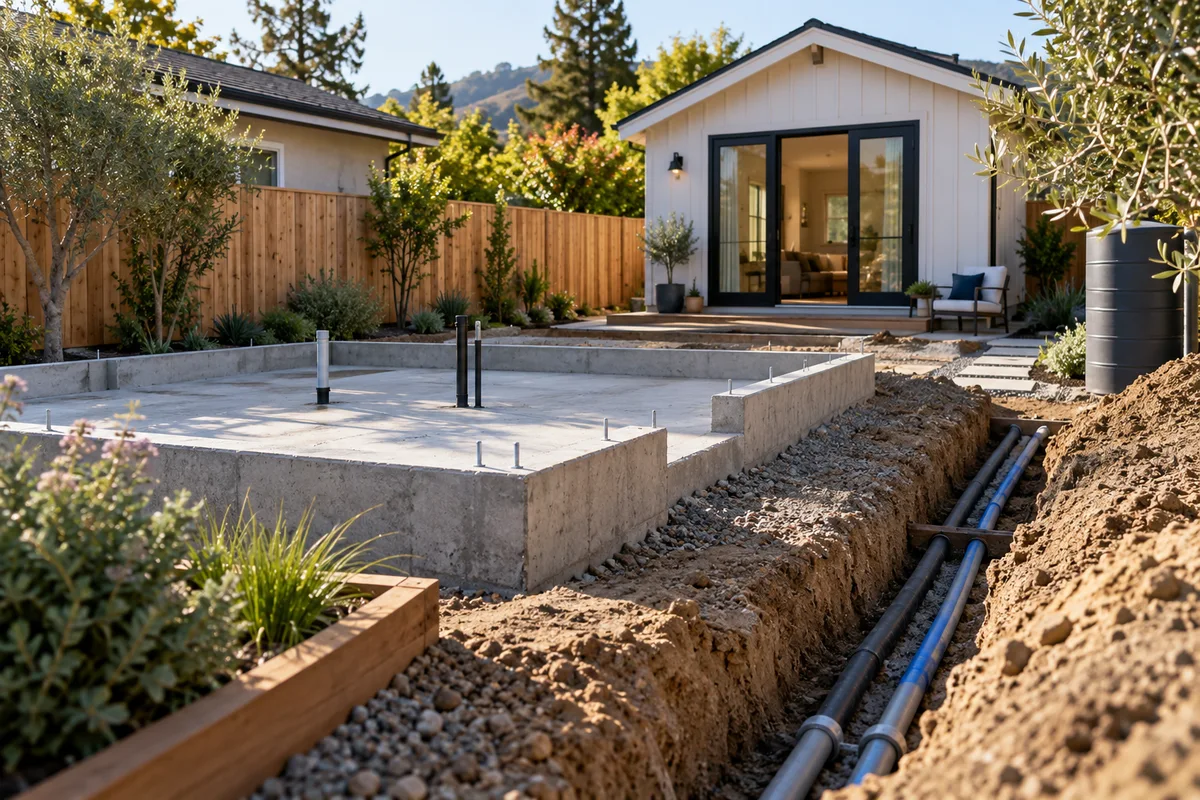
Ask the team to identify demolition, access, excavation, drainage, connection routes and any existing conditions on which pricing depends. The point is not to predict every buried obstacle; it is to state who investigates and how an unexpected condition becomes a priced decision. Review the city San José: ADU FAQ for the relevant application questions.
A hypothetical owner compares two proposals with identical interior finishes. One includes a defined utility route; the other assumes a short connection with additional work billed later. The second headline can be lower without offering a lower total. Request the assumed route and excluded work in writing before making the comparison.
Budget completion, not just construction activity
Include inspection coordination, required testing identified for the design, correction responsibility and closeout documents. Ask who remains engaged until the relevant approvals are complete. A crew leaving the site does not answer whether every permit is closed or every promised document has been delivered.
Also identify owner-purchased items and their delivery dependencies. A missing fixture can affect work that seemed nearly complete. Keep temporary arrangements and disruption costs in your personal project budget even when they are not part of the construction contract. This avoids comparing a contractor total with a whole-project financial commitment.
Run a scope reconciliation meeting
Walk through the budget line by line with the plan set open. For each allowance, ask what quantity or condition it assumes. For each exclusion, identify who will obtain the missing price. For each agency or utility item, record whether the amount is an estimate or an issued charge.
End with a list of the few uncertainties most likely to alter the decision, not a long generic contingency list. Investigate those first. The useful output is a budget whose total and limitations are both visible. It should let you explain why one proposal costs more without relying on unsupported Bay Area average prices or anonymous forum examples.
Use a boundary check on every large line
For each major budget item, ask what begins and ends that scope. A utility line might include trenching but exclude provider charges or restoration. A design line might include drawings but exclude later owner changes. A finish allowance might cover material supply but not a preferred installation detail. Write these boundaries beside the amounts so a total remains understandable.
Then test a plausible change without assigning invented prices. If the proposed connection route changes, which lines move? If the owner selects a different appliance, who checks its effect? If concealed conditions need investigation, which professional is engaged and who authorizes the added scope? These questions reveal whether the budget has an agreed change mechanism.
Keep a separate owner-decision reserve from a documented unknown-condition allowance where useful. Choosing more expensive finishes is different from discovering work necessary for the agreed project. Separating them helps you explain cost growth honestly and prevents every change from being blamed on permits, contractors or an undifferentiated contingency.
Ask for the drawing revision referenced by each proposal. If one builder priced an earlier plan, request reconciliation before comparing totals. Even a detailed budget becomes misleading when its quantities and scope belong to a different version. Keep the reconciliation with the estimate so later decisions have a traceable starting point.
Related questions
Is price per square foot enough to compare ADU bids?
No. It can conceal different site, design, utility and finish scopes.
Should an unresolved fee be counted as zero?
No. Label it unresolved or use an explicitly explained allowance until reliable project-specific information is available.
Official sources
- San José: ADU FAQ
- San José: Building Permit Fees and Estimator
- San José: Preapproved ADU and Site-Specific Application
Why readers ask this question
These public discussions informed the topic. Individual experiences are not permit rules, verified prices or professional advice.